
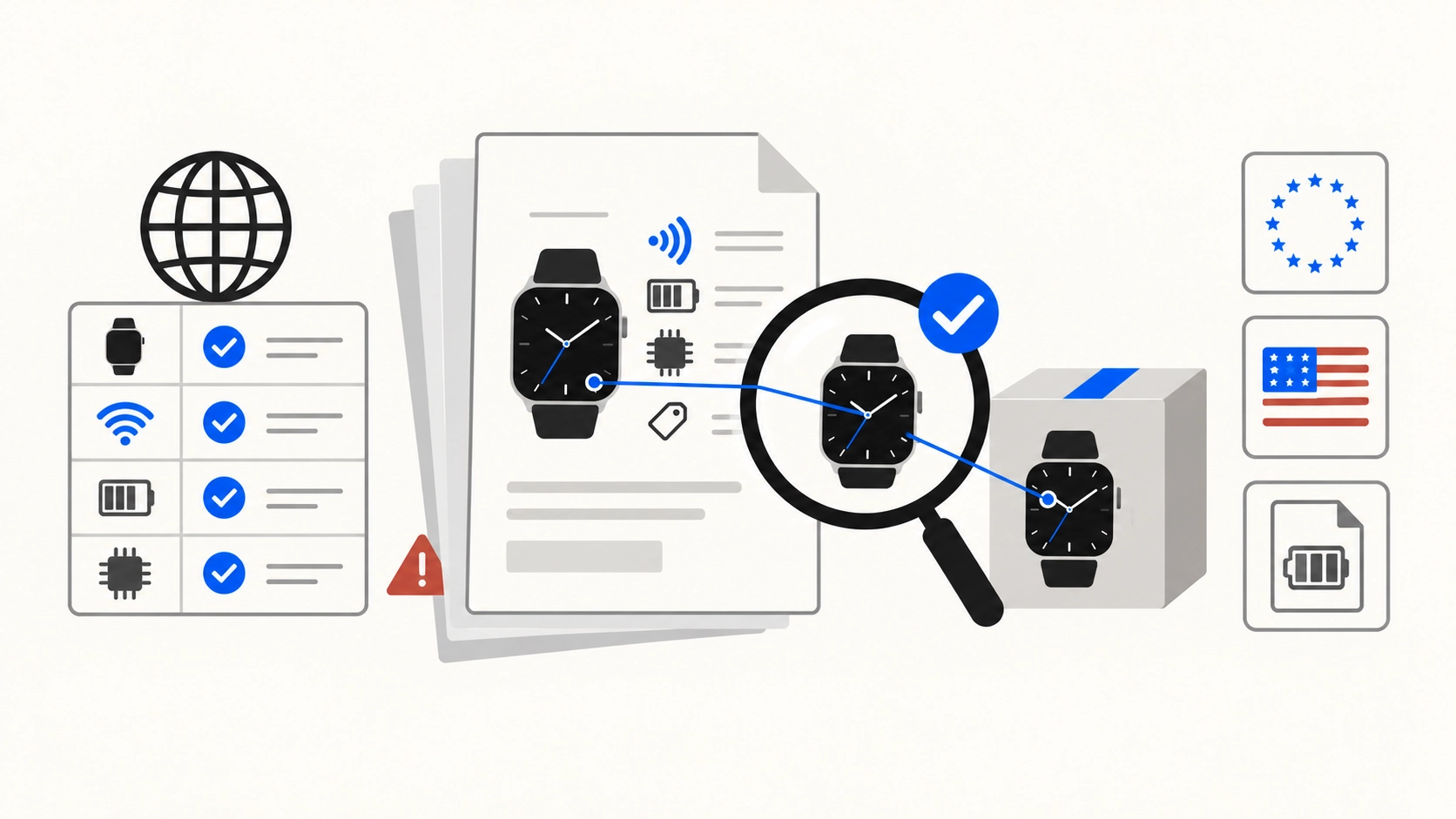
Short answer: there is no single universal certificate pack for every smartwatch or smart-glasses order. The correct documents depend on the exact product, radio functions, battery, intended claims, target country and the buyer’s role in the supply chain. Build a market-specific requirements matrix, then verify every document against the model and configuration you will actually import.
The checklist below is a practical starting point for B2B due diligence. It is not legal advice, and it does not replace a review by a qualified test laboratory, compliance consultant or customs professional for your market.
1. Build the compliance matrix before requesting certificates
Start with five questions:
- Which countries will receive the product?
- Will it be sold online, in retail, through a distributor or as a promotional product?
- Which radios and functions are enabled in the final firmware?
- Which company name or brand will appear on the product and packaging?
- Who will act as manufacturer, importer, authorized representative or other responsible economic operator?
Use the answers to list the applicable product-safety, radio, electromagnetic-compatibility, substance, battery-transport, labelling, language and traceability requirements. A document collected for one market or one configuration may not support another.
2. Request a model-identification pack first
Compliance evidence is only useful when the tested product can be connected to the shipment. Ask for a pack containing:
- the full model name and all variant names;
- hardware, firmware and app versions;
- product, rating-label and packaging photographs;
- radio technologies and operating bands;
- battery cell and pack model information;
- user instructions and safety information;
- the manufacturer and other named responsible parties.
This pack becomes the cross-check for every report, declaration and label file.
3. For the European Union, request more than a CE logo
CE marking is not a universal certificate issued by one central EU authority. It represents the manufacturer’s declaration that the product meets the applicable EU requirements. For radio-enabled wearables, the Radio Equipment Directive is commonly part of the assessment, along with other legislation that may apply to the product and its materials.
Depending on the exact product, ask for:
- an EU Declaration of Conformity identifying the radio equipment type;
- the list of applicable EU legislation and standards, including their versions;
- supporting radio, EMC, electrical-safety, RF-exposure and substance test evidence as applicable;
- technical documentation sufficient to connect the declaration to the product;
- the final CE mark, model, manufacturer, importer or responsible-person label artwork;
- instructions and safety information in the languages required for the destination.
Check whether the declaration covers the same model, radio configuration, accessories and software as the order. If a notified body was involved, verify the body and the scope of its involvement; do not assume that every CE-marked product requires a notified-body certificate.
Consumer products placed on the EU market may also be subject to the General Product Safety Regulation. Among other obligations, the EU framework addresses traceability, safety information, the responsible economic operator and information presented in distance-sales offers. Confirm how these duties apply to your business model before listing the product.
4. For the United States, verify the equipment authorization path
Bluetooth, Wi-Fi and other transmitters are intentional radiators. The FCC generally requires intentional radiators to follow the certification procedure before marketing in the United States. Other digital functions may follow different authorization procedures, and RF-exposure considerations may also apply.
For an FCC-certified configuration, request the FCC ID and verify it in the official equipment-authorization records. Compare the grantee, product description, model list, internal and external photographs, label information, frequency scope and any grant conditions with the unit you intend to import. A report or FCC ID for an electrically different product should not be treated as coverage for the order.
If the supplier refers to a Supplier’s Declaration of Conformity for another part of the device, ask which rule section and responsible party it covers. Confirm the final label and user-manual statements rather than copying a generic template.
5. For lithium batteries, request the UN 38.3 test summary
Lithium cells and batteries offered for transport must have passed the applicable design tests in subsection 38.3 of the UN Manual of Tests and Criteria. Ask for the UN 38.3 test summary for the exact cell or battery type used in the product. The document should allow the battery design and responsible manufacturer or distributor to be traced.
Also request the battery specification and shipping information needed by your carrier or forwarder. Match the cell or pack model, voltage, capacity and manufacturer across the specification, test summary and supplied product. If the battery design changes, review whether the existing evidence still applies.
6. Check product claims, labels and online listings
Compliance is not limited to laboratory reports. Review the final product, packaging, manual, app screens and marketing claims together. Confirm that model numbers, company details, warnings, symbols and language versions are consistent.
For wellness functions, avoid turning general activity or wellness features into medical claims unless the product and evidence support the applicable medical-device pathway in the target market. A sensor feature, app screen or supplier brochure does not by itself establish clinical accuracy or regulatory status.
7. How to verify a document pack
- Match the identity. Compare model, applicant, manufacturer, product photos, hardware, firmware, radio module and battery.
- Check the scope. Confirm the report addresses the required market, function, standard and configuration.
- Check the source. Verify the laboratory, certification body or official database where relevant.
- Check dates and revisions. Confirm the cited standards and documents remain appropriate for the planned placing-on-market date.
- Resolve discrepancies in writing. Ask for a documented technical explanation when names, components or versions differ.
- Control changes. Require notice and approval before changes to radios, batteries, enclosures, firmware or labels.
Documents that should trigger further questions
- a certificate image with no report, model scope or verifiable number;
- a report for a family name without a clear variant list;
- documents naming a different applicant or manufacturer with no relationship explained;
- an FCC ID, CE declaration or battery summary that does not match the supplied label;
- a statement that one document permits sale in every country;
- test evidence for a sample that differs from the final hardware or enabled firmware.
Official reference points
- European Union guidance on CE marking
- EU Radio Equipment Directive
- EU General Product Safety Regulation summary
- FCC equipment-authorization overview
- PHMSA guidance on lithium-battery test summaries
Need a document checklist for a specific wearable project? Browse our product range or send an inquiry with the model, destination market, sales channel and customization plan. We can discuss which product information is available; the buyer should confirm final market-entry obligations with qualified specialists.

